
INTRODUCTION
Breaking Ground — for Women Too
Construction is one of Europe’s most gender-segregated industries. Women represent fewer than 12% of the construction workforce across EU member states, and in Türkiye the figure is even lower. Yet the sector faces a widening skills gap, a green-transition imperative, and a digitalisation wave — all of which demand fresh talent and diverse perspectives.
The ConstructHer Future (CoHer) project, co-funded by the Erasmus+ programme, set out to change this picture through Vocational Education and Training (VET). Rather than tinkering at the margins, the project took a structural approach: reform the curriculum itself, train the educators who deliver it, and design specialised learning pathways that speak directly to women’s experiences and ambitions in construction.
This blog post traces the journey of the Turkish pilot — anchored in Dalaman in spring 2025 — and draws out the practical lessons for any VET provider or policy-maker who wants to move the needle on gender inclusion in the built environment.
THE PROBLEM
Why VET Needs a Gender Lens — and Why Now
Vocational training in construction has historically been designed by men, for men. Curriculum content focuses on physical tasks; imagery on course materials depicts male workers; mentors and role models are overwhelmingly male. For a young woman considering a career in bricklaying, quantity surveying, or digital site management, the message — implicit but powerful — is: this is not for you.
“The curriculum mapping revealed a striking gap: no explicit content on gender perspectives, and virtually no representation of women in technical roles.” — CoHer Curriculum Mapping Analysis, Dalaman 2025
Beyond representation, there are structural barriers: inflexible scheduling that does not account for caring responsibilities, assessment methods that favour rote memorisation over practical reasoning, and a certification landscape that rarely acknowledges partial qualifications or micro-credentials. The CoHer project identified these gaps through a rigorous mapping exercise and used the findings to drive a wholesale curriculum reform.
THE COHER FRAMEWORK
Four Pillars, Six Modules, One Shared Goal
The reformed VET curriculum is organised around four CoHer Pillars that cut across all six subject modules:
- 01 Gender Equality — embedding equitable language, imagery, and assessment design throughout.
- 02 Holistic Skill Development — combining technical knowledge with professional and transferable competencies.
- 03 Future-Focused — integrating digital tools, green building practices, and emerging construction technologies.
- 04 Inclusivity — designing for diverse learners, including women returners, migrants, and part-time students.
The six curriculum modules are:
- Foundations of Safe, Equitable & Sustainable Construction
- Construction Materials & Technologies: Performance, Sustainability & Inclusive Application
- Digital Construction Workflows & Inclusive Collaboration
- Sustainable & Green Building: Environmental Responsibility & Social Equity
- Inclusive Construction Planning, Processes & Site Management
- Holistic Skills & Professional Empowerment in Construction
Crucially, no single partner built a module in isolation. Each was developed collaboratively and then peer-reviewed by the full consortium — including CEKDEV and PIXIE from Türkiye — ensuring that Turkish labour-market realities and cultural contexts were woven into every section.
THE TURKISH PILOT
Three Days in Dalaman: Where Theory Became Practice
In April 2025, partners converged in Dalaman, Turkey, for a three-day intensive joint workshop that simultaneously launched the Curriculum Development process (Activity 1) and piloted the Educator Training Programme (Activity 2). Twenty participants — educators, industry experts, gender specialists, and curriculum designers — gathered to stress-test the CoHer framework under real conditions.
The Learning Carousel
The centrepiece of the educator training was a Learning Carousel: seven thematic stations that educators rotated through in small groups. Each station combined a short input session with a hands-on activity, reflecting the project’s commitment to experiential pedagogy. Stations covered topics from gender-responsive lesson planning to integrating digital tools in the workshop environment.
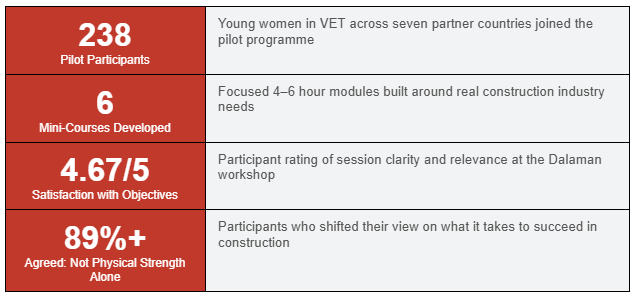
Post-workshop evaluations confirmed the format worked. Participants rated the clarity of session objectives at 4.67 out of 5, and logistical arrangements at 4.75 out of 5. Equally telling were the qualitative comments: educators reported feeling equipped — many for the first time — to actively encourage female students toward technical pathways rather than defaulting to administrative or support roles.
Curriculum Mapping in Action
Alongside educator training, the workshop used a Modified World Café format to map curriculum gaps across the existing Turkish VET offer. Teams rotated through topic tables, identifying where gender-sensitive content was absent, where technical depth was insufficient for today’s industry demands, and where digital literacy was treated as optional rather than core.
The output — a detailed gap analysis — formed the blueprint for the six-module curriculum that partners subsequently developed. This grounding in evidence was deliberate: rather than importing a generic European curriculum into a Turkish context, the team built upward from an honest assessment of where things stood.
SPECIALISED LEARNING PATHWAYS
Six Mini-Courses Built for Women in Construction
Parallel to the curriculum reform, Activity 3 produced six specialised mini-courses — focused, 4–6 hour learning experiences designed specifically to address the confidence, skill, and identity barriers that deter women from progressing in construction careers. Each course passed a Quality Gate Criteria review before moving to pilot testing.
| Mini-Course Title | Lead Partner |
| Leadership & Assertive Communication for Women in Construction | Fundacja Fundusz Inicjatyw (Poland) |
| Introduction to Inclusive Site Logistics & Accessible Planning | Future Cast |
| Green Site, Green Career: Your Role in Sustainable Construction Practices | MORE — Laboratório Colaborativo |
| Materials Matter: Inclusive Handling & Specification Insights | LNTU (Ukraine) |
| Problem-Solving & Resilience: Navigating On-Site Challenges | Creative Youth Academy (Cyprus) |
| Discovering Digital Careers in Construction: Beyond the Trowel and Hammer | PIXIE & CEKDEV (Turkey) |
The sixth course — Discovering Digital Careers in Construction — deserves particular mention because it was led jointly by PIXIE and CEKDEV, the Turkish partners. It directly challenges the assumption that construction digitalisation (BIM, drone surveying, smart site monitoring) is a male-dominated niche, and opens a pathway for women who are tech-literate but unaware that construction offers an expanding range of desk-free, screen-enabled career options.
WHAT THE DATA SHOWED
Pilot Results: Attitudes Shift When Learning Is Relevant
238 participants across seven partner organisations took part in the informal early pilot of the mini-courses. The methodology was deliberately co-creative: pre- and post-tests measured attitude change, ‘Plus/Delta’ feedback sessions surfaced what worked and what needed adjustment, and ‘Think Aloud’ content reviews exposed exactly where learners got stuck or disengaged.
Three findings stood out:
- Finding 1 Attitudes toward women in construction shifted decisively. Over 89% of participants agreed, post-session, that success in construction is not limited by physical strength — a significant movement from baseline responses.
- Finding 2 The ‘Technical Empowerment Hypothesis’ was validated. Participants in the Materials Matter and Problem-Solving modules reported that technical knowledge acted as a ‘credibility shield’ — giving them the confidence to assert themselves in male-dominated environments.
- Finding 3 Format matters as much as content. 83% of participants found sessions ‘definitely engaging’, but they consistently asked for more visuals, more role-model stories, and fewer dense text blocks — feedback that has since been incorporated into the final course versions.
“Technical literacy acts as a credibility shield — it gives women the language and the authority to be taken seriously on site.” — Participant insight, CoHer Pilot Evaluation
RECOGNITION AND CREDENTIALS
Making Learning Count: The CoHer Certification System
Skills without recognition are invisible to employers. The CoHer project addressed this with a two-level credential framework integrated directly into the project’s digital learning platform:
- Level 1 Certificate of Module Completion — awarded for successfully completing any of the six core curriculum modules (requires 100% content engagement and an 80% or above assessment score).
- Level 2 Micro-Credential — awarded for completing a specialised mini-course, providing a lightweight, shareable proof of competence that participants can add to their CV or LinkedIn profile immediately.
The automation of credential issuance — via the MasterStudy LMS platform — ensures that no participant falls through the administrative cracks. Credentials are verifiable and shareable, enabling women to document their upskilling journey whether they are entering the labour market for the first time, returning after a career break, or seeking promotion within an existing construction role.
LESSONS FOR VET PROVIDERS
What Works — and What to Watch
Do: Start With Honest Gap Analysis
The Modified World Café process in Dalaman worked because partners refused to paper over uncomfortable findings. When the curriculum mapping showed near-zero explicit gender content in existing Turkish VET provision, the team documented it plainly and used it as the foundation for reform. Generic ‘diversity statements’ added to existing syllabi are not a substitute for structural change.
Do: Train Educators, Not Just Students
The Learning Carousel approach demonstrated that VET educators — many of whom have decades of classroom experience — respond well to participatory, station-based professional development when it respects their expertise while challenging their assumptions. The practical outputs (a Pedagogical Guide, an Educator Handbook) mean that the Dalaman workshop’s insights survive beyond the event itself.
Do: Make Credentials Portable and Immediate
Women in construction, particularly those juggling study with work or caring responsibilities, need to see a return on their learning investment quickly. Micro-credentials that can be shared on professional platforms immediately after completion dramatically increase the perceived value — and completion rate — of short courses.
Watch Out: Dense Text Alienates Practical Learners
The pilot was unambiguous: participants in VET contexts learn better through visual content, real-world scenarios, and role-model narratives than through text-heavy slides. Course designers should treat visual design as a pedagogical choice, not an afterthought.
CONCLUSION
Construction Is Everyone’s Industry
The Turkish pilot of the ConstructHer project is a proof of concept, but also a proof of principle: when VET systems are redesigned with women’s experiences at the centre — not added on as a footnote — the outcomes are better for everyone. Educators gain new pedagogical tools. Students gain confidence and credentials. And the construction industry gains access to a talent pool it has been systematically excluding for generations.
The six modules, six mini-courses, and certification framework developed by the CoHer consortium are freely available as Open Educational Resources. Any VET provider, skills authority, or employer body that wants to accelerate gender inclusion in construction has a ready-made, evidence-tested starting point — and a growing network of practitioners across Europe who have already made the journey.
About the ConstructHer (CoHer) Project
CoHer is an Erasmus+ funded consortium bringing together partners from Turkey (CEKDEV, PIXIE), Ukraine (LNTU), Cyprus (Creative Youth Academy), Poland (Fundacja Fundusz Inicjatyw), Portugal (MORE), and Ukraine/International (Future Cast). The project aims to reform VET curricula and create open educational resources that make construction careers accessible and attractive to women across Europe and beyond.
